
India's wholesale price inflation surged to 8.30 per cent in April, up from 3.88 per cent in March, primarily driven by a significant increase in the prices of fuel, power, and crude petroleum, according to data from the commerce and industry ministry.

Indian markets on Dalal Street rallied sharply as easing tensions in the US-Iran conflict and stable oil prices boosted sentiment. Track Nifty 50 and BSE Sensex performance and key global triggers.

Equity benchmark indices Sensex and Nifty tumbled in early trade on Monday, with the 30-share BSE Sensex falling 1,613.09 points and the 50-share NSE Nifty plunging 495 points, as the failure of US-Iran negotiations heightened concerns of a prolonged conflict driving crude oil prices sharply higher. Track Sensex, Nifty50 movement and key market drivers for April 13, 2026.

'You set up your SIPs and you do not touch them. Not during COVID, not during a war scare, not when your neighbour tells you the market is finished. You let the noise pass over you.' 'The beauty of this approach is that it does not require courage or conviction in the moment. It just requires inertia -- keep the SIP running and do not look at your portfolio too often.'

The Reserve Bank of India's (RBI) cap on banks' forex positions provided only a temporary boost to the rupee, with the currency quickly reversing gains and breaching the 95-per-dollar mark due to persistent underlying pressures.

The Indian rupee gained 2 paise to settle at 93.33 against the US dollar, driven by positive sentiment in domestic equity markets and renewed hopes for US-Iran talks, despite rising WPI and CPI inflation.

Analysts are revising down India Inc's financial year 2026-27 (FY27) earnings growth forecasts, citing persistently high crude oil prices above $100 a barrel due to the West Asia conflict, which is expected to dent corporate financial performance in the coming quarters.

India has no plans to ration fuel supplies despite ongoing disruptions in global energy markets, according to a top oil ministry official. The country has maintained adequate inventories of crude products and LPG while diversifying imports to manage supply risks.

'Periods of geopolitical uncertainty often see a rise in coordinated cyber threats, disinformation campaigns, and infrastructure targeting.'

Delhi must now purge the delusional hopes of being a 'counterweight' to China in the US calculus, argues Ambassador M K Bhadrakumar.

Despite geopolitical tensions and FII outflows, Indian small and midcap stocks have not only recovered losses but are also outperforming largecap indices, driven by attractive valuations, domestic institutional support, and a rebound in earnings.
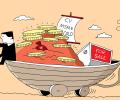
Several non-banking financial companies (NBFCs) are observing an increase in early-stage delinquencies within their micro, small and medium enterprises (MSME) loan portfolios, primarily driven by supply chain disruptions and escalating raw material costs exacerbated by the ongoing conflict in West Asia.

The Indian rupee depreciated by 32 paise to close at 92.83 against the US dollar, influenced by escalating global tensions, particularly the US-Iran conflict, and the deadline for the RBI's instructions to banks to curb overnight positions.

Aviation stocks experienced a significant surge following the announcement of a two-week ceasefire between the US and Iran, which led to a sharp decline in crude oil prices. This development has positively impacted stock markets and the broader economic outlook for India.
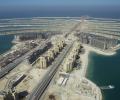
Ongoing geopolitical tensions in West Asia have slowed deal momentum in Dubai's luxury residential market, but Indian high-net-worth individuals (HNIs) are not exiting their marquee assets, with any 'discounted' resale deals attributed to investor liquidity stress rather than geopolitical flight.

'Existing investors who have not acted so far may consider holding on to these funds with the understanding that the higher returns they expected from them may now take longer to materialise.'

The Indian rupee depreciated by 52 paise to settle at 93.35 against the US dollar, driven by failed US-Iran peace talks, surging crude oil prices due to a potential US blockade of Iranian ports, and a global flight to the greenback. This geopolitical uncertainty is also leading to foreign capital withdrawal from domestic equities.

Is Bhutan merely experimenting with digital finance -- or is the Himalayan kingdom punching far above its weight, quietly playing one of the most sophisticated strategic games in Asia today? asks Varun Arya.

Gold prices experienced a significant decline in futures trading due to uncertainty surrounding geopolitical tensions in West Asia and conflicting statements regarding the conflict. Investors are also awaiting key macroeconomic data for further direction on interest rate cuts.

Analysts predict that the ongoing conflict in West Asia, crude oil price fluctuations, and the US Federal Reserve's interest rate decision will significantly influence the Indian equity market this week.

Analysts say long-term investors may still benefit, but recommend limiting bullion exposure to around 10 per cent.

The Confederation of Indian Industry (CII) has proposed a 20-point policy agenda to the finance ministry, including a conflict-linked emergency credit line guarantee scheme and tax rationalisation on energy inputs, to support MSMEs, exporters, and energy-intensive industries affected by the ongoing West Asia war.

'Once the currency goes out of the hand, then possibly your major challenge is that it will not come back.'

The Reserve Bank of India (RBI) Governor Sanjay Malhotra is now confronting the classic growth-inflation tradeoff, a situation exacerbated by the West Asia war, which threatens to end the 'goldilocks period' of low inflation and robust growth.

External Affairs Minister S Jaishankar stated that India has demonstrated resilience in the face of recent global shocks, including the conflict in West Asia, while speaking at the convocation ceremony of IIM Raipur. He emphasised the importance of building national capabilities to de-risk and develop leverage in a changing global order.

Shares of Avenue Supermarts, operator of DMart, fell 5.2 per cent after reporting mixed Q4 FY26 results, with brokerages offering divergent 'sell', 'buy', and 'hold' ratings based on factors like valuation, competitive intensity, and store expansion strategies.

Indian oil marketing companies are incurring significant losses, selling petrol at a Rs 14 per litre loss and diesel at Rs 18 per litre, as elevated global crude oil prices, exacerbated by the West Asia crisis, outpace capped retail fuel rates, according to rating agency Icra.
ICICI Bank reported a 9.28 per cent increase in its consolidated net profit to Rs 14,755 crore for the March quarter of FY26, primarily driven by a nearly 90 per cent reduction in provisioning. The bank's executive director, Sandeep Batra, noted strong asset growth but expressed caution regarding the geopolitical situation in West Asia.

Indian equities on Dalal Street saw volatility as global market trends and fresh tariff concerns linked to Donald Trump impacted investor sentiment. Track Sensex, Nifty50 movement and key market drivers for Feb 24, 2026.
Equity benchmark indices Sensex and Nifty experienced a significant decline, primarily driven by a selloff in IT stocks due to concerns about AI disruption and renewed worries over global trade.

Foreign investors have withdrawn over Rs 88,000 crore from Indian equities this month, driven by geopolitical tensions, a weak rupee, and concerns about rising crude oil prices.

'The West Asia or the Gulf crisis has shown that what we develop as national infrastructure when things are not as bad as they could be, we forget to plan for adversities.'

'Portfolios built in these phases often deliver the strongest outcomes over time.'
'Portfolios built in these phases often deliver the strongest outcomes over time.'
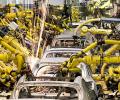
Passenger vehicle sales in India reached a record high of 4.7 million units in FY26, boosted by strong performances from major automakers and the implementation of GST 2.0.

Direct plans of mutual fund schemes added nearly 21 million individual investor folios in FY26 (as of February), surpassing regular plans' 15 million net additions, marking only the second time direct plans have outpaced regular plans in annual folio growth, despite turbulent equity markets.

Gold and silver prices saw a significant decline in the national capital, with silver falling by Rs 7,800 to Rs 2.43 lakh per kilogram and gold by Rs 1,500 to Rs 1.54 lakh per 10 grams, as investors booked profits amid persistent doubts over the durability of the West Asia ceasefire.

India has managed high government debt-to-GDP, a slowing domestic revenue engine, lower household savings and a more hostile geopolitical environment separately in the past. But together, they threaten to undo the growth narrative on which today's optimism rests, warns Debashis Basu.

Gold prices fell by Rs 400 to Rs 1.6 lakh per 10 grams in the national capital on Thursday amid weak global trends and receding expectations of an interest rate cut by the US Federal Reserve.

From the Sensex firms, Tata Steel tanked the most by 4.57 per cent. ICICI Bank, Power Grid, HCL Tech, Tech Mahindra, Infosys and Kotak Mahindra Bank were also among the laggards. Mahindra & Mahindra, State Bank of India, ITC and Bharat Electronics were among the gainers.
 © 2026 Rediff.com - Advertise with us - Disclaimer - Privacy Policy - Sitemap - Feedback - About us - Terms of use - Grievances